
Even if you don’t believe in astrology, this story has a fascinating side. The ancient observers of India noticed natural rhythms that modern astronomy still confirms today.
Jupiter, one of the cosmic energies that shape our lives according to the Vedic science of Jyotish Shastra, has just left Cancer (in Sanskrit, Karka), the sign where it is at its strongest, and moved into Leo. Please don’t confuse this with everyday astrology. Vedic Jyotish is a very different discipline.
And if you are a skeptic, don’t close the tab just yet. We won’t ask you to believe anything. We simply invite you to look at the Vedas as a system for observing time and life, and to draw your own conclusions.
1. The Jupiter cycle is not mysticism, it is astronomy
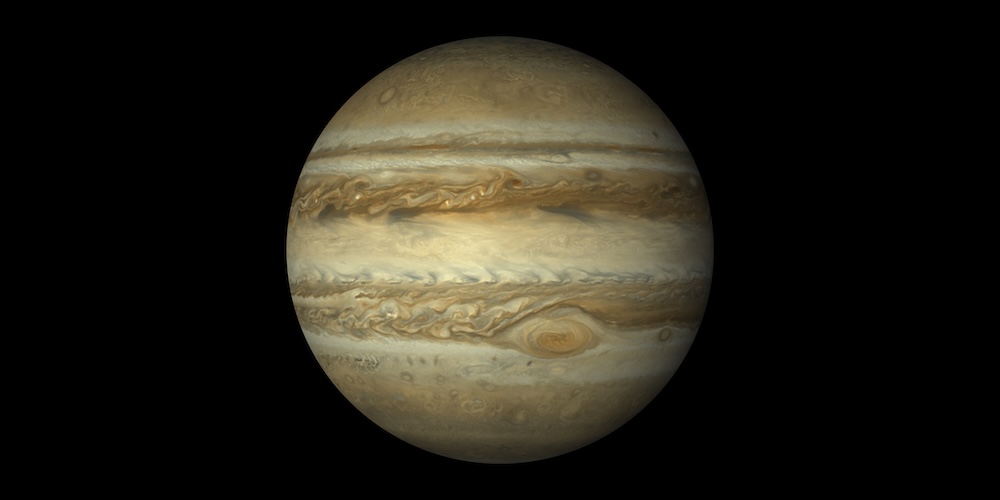
Jupiter circles the sky in roughly twelve years, spending about a year in each sign. Vedic astrology says so, and so does every telescope. This is a measurable fact, not an astrologer’s invention.
In Sanskrit, the energy associated with Jupiter is called Brihaspati, or Guru, which simply means “teacher.”
Here is what is truly remarkable: the Vedic sages tracked this cycle thousands of years ago and built the calendar of public life around it. The best-known example is the Kumbh Mela pilgrimage, held every 12 years and tied precisely to the position of Jupiter. Jupiter enters the Vedic sign of Leo once per cycle, and that is exactly what the Simhastha Kumbh Mela in India is linked to, one of the largest gatherings of people on Earth.
Jyotish Shastra began with patient observation of the sky, not with faith. Just think how many generations it takes to spot a 12-year rhythm without a telescope. Jyotish treats the moment Jupiter leaves its state of “uccha,” or exaltation, as one of the most significant points in this 12-year cycle.
2. “Time has a quality”: an idea you can test on yourself
The core idea of Jyotish, the Vedic science of light, is simple: time is not uniform. Just as every season has its own character, winter one and spring another, the periods of our lives have their own “mood.”
This idea doesn’t come from “old wives’ tales.” It rests on a clear understanding of the cosmic energies that act on us, on careful calculation, and on a concrete system that shows how to live each period as positively and easily as possible, and what support each person needs at each stage of life.
The key principle of Jyotish is this: planetary energies do not “punish” or “reward,” as ordinary astrology often claims. They only show us the quality of the time. What we do with it is up to us.
Until October 31, Jupiter was in “uccha.” In Sanskrit the word means “high.” It is the sign of exaltation, where a planet’s energy shows its best qualities. Classical Jyotish texts such as the Brihat Parashara Hora Shastra call Cancer, the sign Jupiter has just left, the sign where Guru’s energy is raised to its highest. Cancer is governed by the Moon, the symbol of care, nourishment and motherly energy. Here Jupiter’s wisdom becomes soft and warm, rather than dry and bookish.
Jupiter had been in Cancer since June 2 this year. These were months when it was easier to study, support loved ones, sort out family matters and turn to faith.
In Jyotish they say: the higher the Guru, the more generous the blessings of teachers and of life itself.
The Vedic tradition sees Jupiter as the planet of wisdom, learning, mentors and generosity. In Leo it arrives as a symbol of leadership, creativity and inspiration, and also as a reminder that strength without humility turns into pride.
3. Jupiter’s practices work whether or not you believe
The best thing about the Vedas is that their advice can be used even if you don’t accept astrology. For Jupiter, it is strikingly close to what psychology and health science study today:
- Gratitude to teachers and elders. Research shows that practicing gratitude lifts your mood and strengthens relationships.
- Study and reading. Jupiter is the planet of knowledge, and lifelong learning helps keep the brain flexible.
- Generosity. Helping others and sharing what you know deepens your sense of meaning and connection.
- Warm, freshly cooked food. Ayurveda links Jupiter with nourishing meals: lentils, mung beans, ghee, seasonal vegetables. These are healthy habits for anyone.
- Calm and mindfulness. Guru teaches us not to rush important decisions and to give ourselves time to think.
You don’t have to believe in Jupiter to call a teacher, read a good book, or help someone who needs it.
What changes as Jupiter moves into Leo
Leo (Simha) is governed by the Sun, and the Sun is a friendly planet to Jupiter (read: a friendly energy). So this is not a “fall.” It is a move from a soft, homely sign into a bright, regal one. Jyotish describes it like this:
- Wisdom steps onto the stage. In Cancer, Jupiter’s energy cared for and nourished. In Leo it teaches, inspires and leads the way.
- Personality and self-expression take on more weight. Leadership, creativity, authority and recognition come to the foreground.
- The themes of children, education and inspiration grow stronger. Leo corresponds to the fifth house, the house of the mind, creativity and offspring.
- Watch the ego. Jupiter expands everything it touches, and a “royal” sign can expand pride too. So during this period in Leo, the point is to guide others, not to boss them around.

For those who want to go deeper
in Jyotish, the sign is only part of the picture. The nakshatra matters too, the “lunar mansion,” one of 27 divisions of the zodiac. The first 13°20′ of Leo belong to Magha, a nakshatra symbolized by a royal throne, ruled by Ketu and linked to the memory of ancestors. Jupiter entered Magha on October 31, 2026, and this gives its leadership theme a note of continuity: here, power and authority are seen as a responsibility to one’s lineage and tradition. The rhythm of this transit is worth knowing as well, because this is only a preview. In December 2026, Jupiter turns retrograde (vakri in Sanskrit). In January 2027, it slips back into Cancer, and only in June, 2027, does it re-enter Leo for the main transit, which runs until 2028. So Jyotish suggests treating the coming months as a rehearsal: take a good look at the themes of leadership, creativity and self-expression, and avoid rushing into final decisions. In a personal chart, what also matters is which house Leo occupies for you, and that calculation is individual.
Why the Vedas are interesting even to skeptics
The Vedas never ask you to take everything on faith. They are a vast body of knowledge about nature, time, the body and consciousness, built over centuries of observation. Ayurveda, Jyotish, Vastu and the other Vedic sciences are genuine sciences, and many rest on Vedic mathematics and rigorous calculation. The Vedas see a person as part of natural cycles, and modern science keeps coming back to the same themes: biorhythms, seasonal eating, the influence of our surroundings.
Try a simple experiment. For a few months, keep a short journal: what goes well, what feels hard, what inspires you. Then compare your notes with what Jyotish says about that period, and decide for yourself whether it matched. This is how Vedic science itself worked: observe, record, compare, refine. It is the path of a researcher, not a blind follower.
Of course, not everything in ancient texts can be checked with modern methods, and an honest researcher admits that. But dismissing an entire body of knowledge just because it is old would be unwise. It makes more sense to try it, observe, and reach your own conclusion.
If you’d like to learn to live every day in harmony with the rhythms of the Universe, get in touch through Gyana.org to book an individual session.


Leave a Reply